Tuesday, September 28, 2010

DAWN.COM | National | Flood-affected youth being tricked into ‘evil’ jobs

UMERKOT: Floods washed away the infrastructure, economy, houses, hearths crops and livestock and mafias taking advantage of the situation shattered the dreams of our future generations by sending Sindh’s youth into male prostitution.

Floods have made many a princes pauper bringing them to a naught. Their homes, belongings and future prospects all drained down in waters.

Fifteen-year-old Nadeem Chandio of Larkana lost everything to floods and was living with his family in a roadside camp in Hyderabad. He fell in an ugly trap for substance. He was lured for a waiter’s job by an Ustad (mafia man) but is learning to dance. This is only a tip of the iceberg as many thousands of vulnerable children are being trained first to become dancers and subsequently prostitutes. Exploitation of children is now a lucrative business for those in this business and they find ample of opportunities to milk these innocent boys.

Chilling realities came to fore when Dawn’s correspondent bumped into some youths who were staying in hotels near railway stations. The place, it came to knowledge, was previously occupied by some dancing boys which was now replaced by some new comers.

Further investigation revealed that a mafia was on a lookout for flood-affected families and their children.
Posing as gentlemen, mafia people first gel into families through fake kindness and then successfully become guardian of their children by promising job and money both, while children end up as dancing boys who are then sent to festivals, private functions, dance parties and prostitution.

Not only their dreams get shattered but their education, social and physical prospects are totally drowned in the sea of vice. These poor chaps wearing anklets not only dance to the tunes of music but are also used for sexual amusements.


Ustad Hashim Chandio is busy exploiting the vulnerability of such families by hiring their boys for fake jobs while brain-washing their innocent mind with his evil thoughts.

Nadeem is not alone as there are scores of boys from Thatta, Dadu, Ghotki, Sukkur, Larkana, Qambar Shahdadkot and Jamshoro districts and were tricked into becoming dancers and languishing in hotels-cum-sexual amusement dens near Karachi, Lahore and Mirpurkhas railway stations and at places near Badin stop, new bridge, Railway station Hyderabad.

Another 16 year old boy hailing from Tando Adam narrating his ordeals said that he came to Hyderabad three years ago with one of his teenaged relative who said that he was working at a bungalow. The two boys shared the same hotel room where his relative sexually exploited him and eventually he too, became like his relative.

Few among them work as masseurs for enticing such customers. Ustad Chandio’s den is near Mirpurkhas railway station. He blames is diabetes for not letting him do a proper job work and thus teaches dancing to teenage boys and sends them to festivals with each earning Rs1000 to Rs1500 per night, of which he bears expenses of transportation, makeup, laundry, food and accommodation and gives Rs7,000 to parents of each boy.

He doesn’t fear any action for having good relations with local politician while paying police its share regularly.

He says that he is not the only man involved in this business as many Ustads in Sindh and other provinces provide entertainment to politician, feudal lords and police officials, he said.

Recruitment of children for dancing is a severe crime and falls into the domain of child trafficking or forced labour. Moreover, Prevention of Human Trafficking Ordinance 2002 prohibits any kind of exploitation in which children are exposed to abuse.

The government should take serious notice of this, specially, after floods as unemployment and poverty have increased manifold.

It is more likely that children will be exploited by sex traffickers through employment opportunities, said Salam Dharejo, National Manager on Child Labour, Society for the Protection of the Rights of Child (SPARC).

District Police Officer Mirpurkhas, Zulfiqar Maher expressed his unawareness about the presence of dancing boys in his jurisdiction and assured of assigning officers for the job. He said that in the record of Mirpurkhas police no sex trafficker or entertainer boy has ever been arrested.


DAWN.COM | National | Flood-affected youth being tricked into ‘evil’ jobs

Monday, September 27, 2010

US Ambassador visits Nine Zero

What should the minimum stature of a political worker be that warrants a condolence visit from the US ambassador?
US Ambassador visits Nine Zero
Updated at: 1805 PST, Monday, September 27, 2010
KARACHI: US Ambassador Anne Patterson on Monday paid a farewell visit to the headquarters of Muttahida Qaumi Movement (MQM) Nine Zero and expressed condolence on the demise of former convener Rabita Committee Dr Imram Farooq.

She was accompanied by US Consul General in Karachi William Martin. She was received by the deputy convener MQM Rabita Committee Dr Farooq Sattar.

Later, talking to media Dr Farooq Sattar said that MQM leadership expressed concerns over the conviction of Pakistani scientist Dr Afia Siddiqui by US court.

The party also sought US support and influence in seeking security for MQM leader Altaf Hussain in London, he added.

Dr Sattar said that US Ambassador expressed condolences over the assassination of Dr Imran Farooq in London.


US Ambassador visits Nine Zero

Friday, September 24, 2010

Higher Education and Technological Advances as Countries Develop-Becker - The Becker-Posner Blog

Policy-making in Pakistan is out of sync with the rest of the world. While the leading economic thinkers recognize the importance of higher education for developing countries, the government in Pakistan has cut-off funding for higher education, leading the public sector universities to go on strike.

It is an amazing coincidence as to what appeared on the Becker-Posner blog this week. Every one involved with the higher eduation Pakistan should give the following comments by Professor Gary Becker, a noble laureate in economics, a thorough read:

The essence of traditional international trade theory is that poorer countries produce goods and services with resources that they have in abundance, mainly low skilled labor and sometimes natural resources. They export these goods, and import goods from the richer countries that require skilled labor, and considerable physical and financial capital. This theory provides many insights, and must be followed if poor countries are to start on the path of economic development. However, it does not go nearly far enough in mapping out how countries can continue rapid development, and go from being poor to becoming middle-income, and eventually to becoming rich.
To continue their economic progress, developing countries have to move up the product ladder and start producing more sophisticated goods. To do this, they need to import technologies from the rich counties, and increase the training and education of their populations. Advanced technologies are partly acquired through foreign direct investment and from trade with rich countries. Along with the more sophisticated goods and services imported, developing countries also acquire some of the technologies developed in the economically advanced nations.
Importing advanced technologies can carry developing countries to middle income status. To eventually reach much higher income levels, these countries must begin to innovate themselves as well. International trade and foreign direct investment are also necessary for this further stage of economic growth, but it is not sufficient. Continuing rapid development toward becoming a rich country requires skilled entrepreneurs and workers who can not only utilize and adapt technologies imported from developed countries, but who can also create develop their own technologies and processes.
Several ingredients are needed to accomplish this- of course, particularly important are competitive markets and creative entrepreneurs- but in the limited space for the present discussion I want to stress the role of education, especially higher education. In early stages of economic development, a country needs a literate and energetic population with a wide education base of perhaps only a few years. But as countries continue to grow, they need to upgrade their education levels beyond elementary school toward high rates of secondary school completion among young persons.
Economists and other students of economic development have learned only in recent years about the great significance also of higher education for countries that want to progress beyond middle-income status. Higher education has become important to the development process mainly because of the growing value in the modern world of command over information and knowledge. The spread of university education and training toward a much larger fraction of young persons is crucial to producing efficiently the kinds of products and services that would help developing countries continue to drive forward.
For several years, along with others, I have been studying the worldwide boom in higher education in both developing and developed nations. These studies document that the rates at which young men, and especially young women, have been graduating from universities have accelerated in almost every country during the past 30 years. China, for example, has had a growth in enrollments at universities of both young men and women since about 1990, and a sharp growth since the late 1990s. A similar rapid expansion of higher education has also occurred in many other still developing countries, such as South Korea. Developed countries too have generally also greatly increased enrollments at universities, although the US has fallen behind in the fraction of young men who go on from high school to receive a college education.
The signal given to young persons that higher education pays off much more now than in the past is the sizable growth during the past several decades in the average earnings of individuals with a college education compared to the earnings of those who do not go to college. Earnings of persons with college education increased faster in recent decades not only in developed countries, but also in many rapidly developing countries, such as China and Brazil, that are supposedly specializing in goods that use less human capital. Developing countries imperil their continued economic advance if they fail to provide much greater opportunities for their young men and women to achieve a university education.
To conclude, the main message of my comments is that in order for poorer countries to continue to grow at fast rates, they must move beyond specialization in goods produced with relatively unskilled labor. They need to upgrade the goods they produce by utilizing more advanced technologies, and more skilled workers and entrepreneurs. At first, most advanced technologies are imported from other countries, but eventually developing nations need to produce themselves many of the technologies required to upgrade and expand their production. To accomplish this last great stage of economic development, both public policy and private households and businesses must begin to emphasize higher education, and other ways to greatly improve the advanced human capital of working men and women.


Higher Education and Technological Advances as Countries Develop-Becker - The Becker-Posner Blog

Wednesday, September 22, 2010

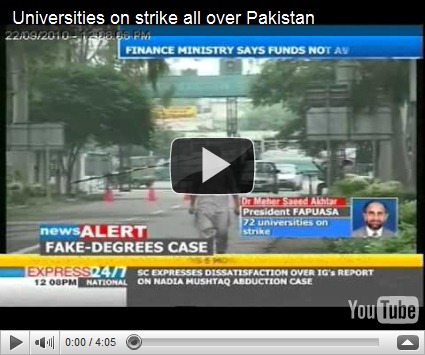
Universities in Pakistan go on strike

Public sector university teachers have gone on strike after the government slashed the higher education budget.

The state machinery has started to slowly shut down because of mismanagement and the havoc caused by the floods.

AFP: Pakistan floods hit more than 10,000 schools: UN

From AFP:
SLAMABAD — Pakistan's flood crisis has damaged more than 10,000 schools, affecting several million pupils and requiring massive investment in a nation struggling with literacy, the UN warned Wednesday.

Torrential rain began falling in northern Pakistan in July and the floods have since moved slowly south, wiping out villages and farmland, and affecting an area roughly the size of England.

"Five to six percent of all schools have been damaged by the floods. This means that between 1.5 to 2.5 million students have been affected," Umar Amal, an official with UNESCO, told a news conference.

"That number can rise and it will rise," he said, unable to estimate how much it would cost to repair the damaged infrastructure.

The United Nations has issued a record two-billion-dollar appeal to cope the disaster, which UN agencies say affected 21 million people and and left 12 million in need of emergency food aid.

Amal said more than 9,780 government schools were damaged -- 2,700 fully and 7,000 partially.

The number of private schools affected -- a statistic he said was not yet available -- would push the figure beyond 10,000, he said.

The UN Children's Fund has said over 10 million children have been affected by the flooding, including 2.8 million under five-year-olds.

Education standards are poor in much of Pakistan, particularly in the most impoverished, rural areas worst hit by the floods.

Primary school enrollment is around 57 percent and government expenditure on education accounts for just 2.1 percent of Gross Domestic Product.

The overall adult literacy rate is 57 percent and Pakistan has three years to meet a Millennium Development Goal target of 88 percent.

But many of the flood-affected areas have far worse rates -- for example in rural parts of southwestern province Baluchistan female literacy can be as low as seven percent, Amal said.

"Already before the floods, they were lagging behind... If 9,000 schools are partially damaged and 2,000 schools fully damaged you need a huge investment in education to re-activate it," he warned.

The UN Office for the Coordination of Humanitarian Affairs said a further 5,563 schools are still being used to shelter about 567,000 people displaced in the crisis.


AFP: Pakistan floods hit more than 10,000 schools: UN

Censorship of The Economist: Blacked out | The Economist

From the Economist:

SINCE January 2009 The Economist has been banned or censored in 12 of the 190-odd countries in which it is sold, with news-stand (as opposed to subscription) copies particularly at risk. India, the only democracy on our list, has censored 31 issues and at first glance might look like the worst culprit. However its censorship consists of stamping “Illegal” on maps of Kashmir because it disputes the borders shown. China is more proscriptive. Distributors destroy copies or remove articles that contain contentious political content, and maps of Taiwan are usually blacked out. In Sri Lanka both news-stand and subscription copies with coverage of the country may be confiscated at customs. They are then released a couple of weeks later (sometimes sooner if the story is also reported by another news outlet). In Malaysia the information ministry blacks out some stories that it judges may offend Muslims, among other things. And in Libya, four consecutive editions were confiscated in late August/early September 2009, the first of which featured a piece critical of Muammar Qaddafi.

Images can also prompt action. The cover of last year's Christmas issue showing Adam and Eve was censored in five countries. Malaysian officials covered up Eve's breasts. Pakistan objected to the depiction of Adam, which it said broke a prohibition on depicting Koranic figures.


Censorship of The Economist: Blacked out | The Economist

Monday, September 20, 2010

Al-Ahram newspaper defends doctored photo of Hosni Mubarak | World news | The Guardian

Altered image in state-run paper shows Egyptian president in lead role at Middle East peace talks

Al-Ahram's Photoshopped image of President Hosni Mubarak at the Middle East peace talks. Al-Ahram's doctored image of Egyptian president Hosni Mubarak and other leaders at the Middle East peace talks in Washington. Photograph: Al-Ahram

Egypt's oldest newspaper today defended its decision to publish a doctored photograph that appeared to put president Hosni Mubarak at the forefront of key figures at the Middle East peace talks in Washington.

The original photo showed US president Barack Obama walking in the lead on a red carpet, with Israel's prime minister Binyamin Netanyahu, the Palestinian president Mahmoud Abbas, Mubarak and Jordan's King Abdullah II slightly behind.

But the state-run Al-Ahram newspaper altered the image in its Tuesday edition to show Mubarak in the lead, with Obama slightly behind him to his right, then placed it over a broadsheet article titled "the Road to Sharm El Sheikh", referring to the Egyptian Red Sea resort that hosted the second round of negotiations.

US President Barack Obama leads President Hosni Mubarak.
The original photograph of the five leaders. Photograph: Alex Wong/Getty Images

Egyptian bloggers and activists said the picture was an example of the regime's deception of its own people. Critics also said the photo was an attempt to distract attention from Egypt's waning role in the Middle East peace process.

But the newspaper's editor-in chief, Osama Saraya defended the decision in an editorial today, saying the original photo had been published on the day talks began and the new version was only meant to illustrate Egypt's leading role in the peace process.

"The expressionist photo is … a brief, live and true expression of the prominent stance of President Mubarak in the Palestinian issue, his unique role in leading it before Washington or any other," Saraya wrote. The photo is still posted on the newspaper's website.

Opponents of Mubarak's near three-decade rule seized on the controversy to criticize the government, which is accused of widespread abuses aimed at suppressing dissent. Wael Khalil, the Egyptian blogger who first called attention to the altered photo, said it was a "snapshot" of what he called daily deception about a number of issues, including democratic change and social justice.

"They lie to us all the time," he said. "Instead of addressing the real issues, they just Photoshop it."

Saraya accused critics of launching a smear campaign against Al-Ahram, which was first published in 1876. The newspaper has enjoyed the widest circulation in Egypt but has faced a growing challenge in recent years from a new breed of private publications and the internet.

It is not unusual for Egyptian newspapers to retouch pictures of senior officials to improve their appearance or light.


Al-Ahram newspaper defends doctored photo of Hosni Mubarak | World news | The Guardian

The Associated Press: Pakistan floods renew heated debate on dam project

Pakistan floods renew heated debate on dam project

ISLAMABAD — This summer's floods in Pakistan have reopened a quarter-century-old debate on whether to build a large hydroelectric dam on the River Indus, a dispute that has split the nation along regional lines. Supporters say the water reservoir could have prevented much of the floods' devastation and boosted agricultural production along the river. Opponents say just the opposite.

The debate over the Kalabagh Dam shows how the worst natural disaster in Pakistan's history, affecting some 20 million people, has unearthed deep fissures in its society. There is a chronic mistrust among Pakistan's four provinces and the central government, and critics accuse wealthy landowners of naked self-interest in wanting to ensure the Indus keeps irrigating their crops.

Kalabagh is in eastern Punjab province, the country's most populous and prosperous region, where the glacier-fed River Indus moves from northwestern mountains to plains and nourishes millions of acres (hectares) of wheat, cotton and sugar cane crops. The dam was first proposed in 1984, but political sensitivities mean it has never passed the planning stage.

In the northwest, politicians and farmers fear the dam could mean more flooding and not less. They say if the dam's reservoir was full, surplus water would be diverted into some districts in the region. South of Punjab, where the Indus runs into the Arabian Sea, they fear the dam would mean drought and poor crops. Both regions ultimately think that it would give Punjab even more economic and political clout.

The governor of Punjab dismisses the arguments as "nonsense."

"It is an emotional issue that they play up and say the 'Punjabis are stealing your water,'" said Salman Taseer, a vocal proponent of the dam. "It is a storage dam, it is not diverting any water. The studies have been done. It is cheap to build, near the national grid and the studies have been done. Kalabagh is ideal in every way."

This year's floods began six weeks ago in the northwest after exceptionally heavy monsoon rains. The deluge slowly worked its way down the Indus and its tributaries, washing over at least 3 million hectares (7.4 million acres) of farm land, and destroying or damaging more than 1.8 million homes.

Shams-ul-Mulk, a former chairman of Pakistan's Water and Power Development Authority and a strong supporter of the dam, said even a "common man" could see that having the dam in place would have mitigated the floods.

The Indus already has two large dams on it. He said one of them, the Tarbela Dam, was able to control water flows of 238,000 cubic feet per second just days before the July 29 floods. The proposed Kalabagh Dam, which would lie further south, could handle another 300,000 cubic feet per second of water that would be gradually released down the country.

Meteorological official Riaz Khan said that at their peak, the floodwaters in southern Pakistan flowed at 1.15 million cubic feet per second.

"The floods wouldn't have been a monster" with the dam, said Mulk, who is himself from the northwest.

No one disputes the electricity that would be supplied from the dam would benefit the whole country. Pakistan has for years struggled with electricity shortages, leading to outages for up to 16 hours a day in some areas and damaging industrial growth. The suffering is worst in summer, when the temperatures soar but power cuts mean fans and air conditioners won't work.

Studies show the dam would generate some 3,400 megawatts of electricity and could be built in under five years.

Still, few outside Punjab support it.

Leaders in the northwestern province of Khyber-Pakhtunkhwa say the dam will destroy farmlands in the Peshawar valley — the main source of agriculture in the region — as water from its reservoir would seep into surrounding land, raising the water table.

They also fear the dam would force incoming floodwaters to spread to areas beyond the already vulnerable district of Nowshera, which is susceptible because of its geography and was badly hit in this summer's deluge.

"We will never let it happen," said Bashir Bilour, a senior minister in the northwest province.

Mulk disagreed, saying the proposed Kalabagh dam's site is too far south of Nowshera district to worsen any flooding in the northwest.

Aurangzeb Khan, 57, who owns a farm on the outskirts of Peshawar city, opposes it. He said before the construction of the two dams in the province decades ago, his land used to yields fruits such as grapes and oranges.

"It's been years since I can recall them growing. More dams mean lesser or no crops at all" because the land is too soaked with water, he said.

In southern Sindh province, there are fears Punjab will use the Kalabagh dam to hog water, meaning even less will reach their farmlands. That could also lead to greater salination. Waters from the Indus help hold back salt water flowing in from the Arabian Sea that inundates increasing amounts of the delta region.

"The dam means our lands will turn into deserts," said Khaliq Junejo, vice chairman of a Sindhi nationalist party.

Punjab's governor alleged the resistance in Sindh was being led by wealthy feudal landowners whose sole interest was personal profit.

"They are all occupying huge areas, that is one reason that they don't want the Kalabagh Dam," Taseer said.

Tahir Qureshi, an adviser with the International Union for Conservation of Nature, said Pakistan could build multiple dams, but it first has to introduce an efficient water management scheme and upgrade its canal system, otherwise it risks drying out Sindh.

While the fierce debate over the dam is likely to rage on, its politics are so perilous it looks unlikely to be built soon. Two of Pakistan's military rulers who backed the project, Pervez Musharraf and Zia ul-Haq, were unable to push it through during their tenures.

The current civilian administration has avoided taking a clear stand. The ruling Pakistan People's Party would risk alienating its main support base in Sindh and coalition allies both there and Khyber-Pakhtunkhwa if it pushed for the dam.

For now, President Asif Ali Zardari favors pursuing smaller, less controversial projects instead.

"Until there is national consensus on it, we should not insist on it and seek to build small and medium dams for which sites have already been identified at various locations in all provinces," his spokesman Farhatullah Babar said.

Associated Press writers Chris Brummitt in Islamabad, Riaz Khan in Peshawar, and Ashraf Khan in Karachi contributed to this report.


The Associated Press: Pakistan floods renew heated debate on dam project

DAWN.COM | Pakistan | Flood victim torches himself outside PM house

It will be foolish for the ruling elites in Pakistan to think that the anguish faced by the millions of flood victims will not turn into anger against those who have the very job to protect the vulnerable.

The man who set himself on fire outside Prime Minister's Gilani's house is not the only father of four left incapable by the floods to cater for his househld. There are million others and they may not direct their frustration at themselves. They may turn into rage against the civil and military elite that has denied the poor their fare share.

It is still not too late to return to the very poor of Pakistan what was there to begin with.

DAWN.COM | Pakistan | Flood victim torches himself outside PM house

Friday, September 17, 2010

Pinpointing the causes of Pakistan's devastating floods - World - NZ Herald News

Pinpointing the causes of Pakistan's devastating floods - World - NZ Herald News
By Jesse Dykstra

So why has this monsoon season caused the worst flooding in Pakistan's history? The overall impression given by the media is that this year's flood is unprecedented. But is it?

On July 29, 2010, nearly 300 mm of rain fell in parts of the upper Indus catchment. As should be expected during the summer monsoon season, this very heavy rainfall was followed by additional precipitation in the headwaters of Indus catchment. Over one month later, flood waters in the lower reaches of the Indus (where most people live), have only begun to recede.

So is such a wet summer monsoon season unheard of? Knowing that it is not unheard of for 10,000 mm of rain to fall over a period of approximately four weeks during July and August in some parts of the southern Himalaya, a back of the envelope calculation suggests an average daily rainfall of nearly 170 mm, for 60 days straight! So it would appear that at least in the wettest regions of the Himalaya, 300mm in 24 hours is a somewhat regular occurrence.

Science Provides a Warning

Looking for more concrete evidence, I did a quick search of the literature, which brought up a recent paper appropriately titled "Flood risk assessment of the River Indus of Pakistan" (Khan et al., 2010, Arabian Journal of Geosciences). The authors estimated the future risk of flooding in the Indus valley by expanding upon the mathematical distribution of the last 60 years of historical river gauge data for peak river discharge, in order to simulate future flood events. The Indus river system is the primary source of hydroelectric generation in Pakistan, with several crucial dams and reservoirs in the lower catchment.

The authors' results showed that the design capacity of many of the various dams and spillways on the River Indus were barely sufficient to handle a one in 20 year flood event. For example, at the GUDDU dam site, which is designed to handle a maximum discharge of 1.2 million cubic feet per second (cfs), the authors estimated that the 1 in 18 year flood event would have a peak discharge of nearly 1.1 million cfs. The authors concluded that "there is an urgent need to construct new dams/barrages on the River Indus and to increase the spillway capacity of reservoirs".

A few months on, these warnings have a prophetic air. On the 8th of August, 2010, the gauge at the GUDDU dam site peaked at 1.16 million cfs, or approximately a 1 in 20 year flood event. Other gauges on the Indus tell a similar story - this does not appear to be an exceptionally large flood event for the Indus River. In fact, based on historical evidence, we should expect similar peak discharge at least once every 20 years. Despite this, the results of the latest flooding have been catastrophic. Why?

A Country of Extremes

Pakistan is a country of geographical extremes, from the extensive deserts and plains of the Indus valley delta in the south, to the lofty heights of the Karakoram Himalaya in the north. With an area of approximately 800 thousand square kilometres, Pakistan encompasses an area nearly three times the size of New Zealand. The River Indus and its' tributaries are the lifeblood of Pakistan and 170 million people depend upon the river for clean water, agriculture and hydroelectricity. The River Indus provides the water to irrigate vast tracks of agricultural land that would otherwise be parched for 9-10 months of the year.

All this irrigated land requires a massive system of dams, reservoirs, levees and canals. Now one of the world's premiere agricultural producers, Pakistan has the largest contiguous irrigation system in the world. All these structures have been engineered to capture, store and divert the precious waters of the Indus and its tributaries. The resulting conversion of flood channels, grasslands, wetlands and even desert into arable land has fundamentally changed the natural flow regime of the Indus.

Quite simply, the river system no longer has the capacity to convey significant flood events out to sea. As has been tragically illustrated over the past few weeks, even a one in 20 year flow events can result in catastrophic flooding. Unfortunately, this means that the increasing millions of people who occupy and farm the floodplains of the lower Indus river valley will continue to be vulnerable to future flood events.

Jesse Dykstra is a PhD student in the Natural Hazards Research Centre at Canterbury University. View his work and that of 30 other scientists and science writers at Sciblogs, New Zealand's largest science blogging network.