Mohammad Haneef of BBC has the courage to identify those behind the sectarian warfare in Pakistan. He is rightly pointing out the fact that it is easy to eliminate Shias in Pakistan than mosquitoes.
پاکستان میں مچھر مارنا زیادہ مشکل اور شیعہ مارنا آسان
http://www.bbc.co.uk/urdu/columns/2011/09/110923_shia_column_hanif_zs.shtml

Friday, September 23, 2011


Wednesday, September 21, 2011
Where are the women tax payers in Pakistan? | Blog | DAWN.COM
Nowhere else is the gender gap more pronounced in Pakistan than in the income tax rolls where more than 99 per cent tax payers are listed as males.
With almost 50 per cent of the population, women account for less than 1 per cent of all income tax payers in Pakistan. The reason for women’s absence from income tax rolls perhaps lies in the manner women are integrated in the workforce. Women’s labour force participation rate in Pakistan is rather dismal at around 14.4 per cent. Bangladesh, on the other hand, reports a three-times higher rate than Pakistan for women’s participation in the labour force. Furthermore, women in Pakistan are often employed in low paying jobs or jobs that do not compensate monetarily. However, the above arguments fail to explain why fewer than 1 per cent income tax payers are women.
It is not that Pakistan lacks affluent women. There are several empowered, influential, and wealthy women in Pakistan such as Begum Abida Hussein (who represents the landed gentry), Sharmila Farooqi (who represents the new breed of female political mavericks), and Dr. Maleeha Lodhi (who represents the intellectual elite). Could it be true that this very visible minority of enfranchised women obscure the fact that despite their prominence they belong to a very small cohort which accounts for fewer than 1 per cent of the taxpayers in Pakistan. Or it is true that women are reluctant to file income tax in Pakistan.
Where are the women tax payers in Pakistan? | Blog | DAWN.COM

With almost 50 per cent of the population, women account for less than 1 per cent of all income tax payers in Pakistan. The reason for women’s absence from income tax rolls perhaps lies in the manner women are integrated in the workforce. Women’s labour force participation rate in Pakistan is rather dismal at around 14.4 per cent. Bangladesh, on the other hand, reports a three-times higher rate than Pakistan for women’s participation in the labour force. Furthermore, women in Pakistan are often employed in low paying jobs or jobs that do not compensate monetarily. However, the above arguments fail to explain why fewer than 1 per cent income tax payers are women.
It is not that Pakistan lacks affluent women. There are several empowered, influential, and wealthy women in Pakistan such as Begum Abida Hussein (who represents the landed gentry), Sharmila Farooqi (who represents the new breed of female political mavericks), and Dr. Maleeha Lodhi (who represents the intellectual elite). Could it be true that this very visible minority of enfranchised women obscure the fact that despite their prominence they belong to a very small cohort which accounts for fewer than 1 per cent of the taxpayers in Pakistan. Or it is true that women are reluctant to file income tax in Pakistan.
Where are the women tax payers in Pakistan? | Blog | DAWN.COM
Half a dollar a day 'adequate', says panel
Half a dollar a day is "adequate" for an Indian villager to spend on food, education and health, the country's main planning body has said.
Critics say that the amount fixed by the Planning Commission is extremely low and aimed at "artificially" reducing the number of poor who are entitled to state benefits.
There are various estimates of the exact number of poor in India.
Officially, 37% of India's 1.21bn people live below the poverty line.
But one estimate suggests the true figure could be as high as 77%.
The Planning Commission has told India's Supreme Court that an individual income of 25 rupees (52 cents) a day would help provide for adequate "private expenditure on food, education and health" in the villages.
BBC News - India: Half a dollar a day 'adequate', says panelFriday, September 16, 2011
Expatriates of the world, unite!
Expatriates of the world, unite! | Blog | DAWN.COM
In the last fiscal year alone, overseas Pakistanis remitted over $11 billion, which accounts for almost 7 per cent of the national economy. On the other hand, total tax revenue generated in Pakistan accounts for 10 per cent of the GDP. Since expatriates contribute such huge sums to their motherland, it may be prudent to formalise expatriates’ role in securing Pakistan’s faltered economy.
One can propose reserved seats for expatriates in Pakistan’s Senate or the Parliament, or permanent representation in the Planning Commission or the State Bank to secure their sustained contributions to the economy. If this proposition seems farfetched, then expatriates may consider launching a development bank or a credit union to gain more control over remittances to Pakistan, which are expected to hit $14 billion next year.
Remittances pouring into Pakistan far exceed the social sector spending by the federal government. In the recent federal budget, the development expenditure is approximated at $5.2 billion, which is again much less than the $11 billion in remittances. Furthermore, remittances are an order of magnitude higher than what Pakistan receives in aid from development banks and donors for social sector spending...
In the last fiscal year alone, overseas Pakistanis remitted over $11 billion, which accounts for almost 7 per cent of the national economy. On the other hand, total tax revenue generated in Pakistan accounts for 10 per cent of the GDP. Since expatriates contribute such huge sums to their motherland, it may be prudent to formalise expatriates’ role in securing Pakistan’s faltered economy.
One can propose reserved seats for expatriates in Pakistan’s Senate or the Parliament, or permanent representation in the Planning Commission or the State Bank to secure their sustained contributions to the economy. If this proposition seems farfetched, then expatriates may consider launching a development bank or a credit union to gain more control over remittances to Pakistan, which are expected to hit $14 billion next year.
Remittances pouring into Pakistan far exceed the social sector spending by the federal government. In the recent federal budget, the development expenditure is approximated at $5.2 billion, which is again much less than the $11 billion in remittances. Furthermore, remittances are an order of magnitude higher than what Pakistan receives in aid from development banks and donors for social sector spending...
Sunday, September 11, 2011
“They killed my husband for no good reason” | Blog | DAWN.COM

David Barkway’s remains were never recovered. The site of former World Trade Centre in New York became his entombment where he died in the North Tower on September 11, 2001.
David and I worked on the trading floor of BMO Nesbitt Burns. David was one of the traders on the fixed income derivatives desk where I served as a data analyst. For more than a year, I sat across from David with a row of computer monitors between us.
I joined Nesbitt Burns in 1995. There were four traders on the desk of which three were oddly named David. With a shy smile and a polite demeanour, David Barkway was unlike any other trader on the then Canada’s largest trading floor. Whereas most traders were self-centered egotists, David, on the other hand, was the humble, caring, gentleman type with thoughtful brown eyes partially obscured by his glasses.
On the fateful morning of September 11, 2001, David went for a meeting with a bond trading firm, Cantor Fitzgerald, whose offices were located between the 101 and 105 floors in the North Tower. Cantor Fitzgerald’s employees got stuck in the building after the plane struck at a lower floor. The firm lost 658 employees on September 11...

Wednesday, September 7, 2011
Bartered in marriage: The bride exchange in rural Pakistan
Your urban feminist sensibilities (even if you are a man) may be offended to learn that two economists from the World Bank have determined that women married in watta satta (barter) marriages face less marital discord than the rest in rural Pakistan.
Barter marriages involve the simultaneous marriage of a brother-sister pair from one family to a sister-brother pair in another family. Thus, when a man marries a woman, his wife’s brother simultaneously marries the man’s sister. The practice is common in rural Pakistan.
Barter marriages are often despised by the urbanites, who consider the practice to be a reflection of tribal customs common among illiterate and low-income households. There are numerous reported cases of women (and men) married off in watta satta exchanges against their will, and who were later subjected to domestic violence. The literature on gender equity holds a disparaging view of barter marriages and considers such unions a violation of womens’ basic human rights. How then can two leading economists from the World Bank, Ghazala Mansuri and Hanan Jacoby, conclude that the likelihood of marital discord in barter marriages is lower than in non-barter marriages? ...
Bartered in marriage: The bride exchange in rural Pakistan | Blog | DAWN.COM
Wednesday, August 31, 2011
Religious tolerance in Pakistan
Religious tolerance in Pakistan | Blog | DAWN.COM
Imagine first the bustling streets of Anarkali in Lahore or Qissa Khawani Bazaar in Peshawar. Now imagine a Hindu or a Jewish person praying on the roadside. If religious tolerance had prevailed in Pakistan, this would be a non-issue as people would simply walk by the praying person.
While I can only speculate how Pakistanis would behave around a non-Muslim praying along the street, I need not wonder how Americans would react to a Muslim praying along the street side.
Just outside the store window in uptown Manhattan (New York), I see a Muslim hawker performing his Afternoon (Asr) prayer on the street side at the intersection of 7th-avenue and West 35th street. He sells DVDs and children’s books in the heart of Manhattan. As he prays, women in shorts and men wearing T-shirts walk by his kiosk. No spectacle is created, or worse no insults or taunts are hurled.
The killing fields of Pakistan | Blog | DAWN.COM
The killing fields of Pakistan | Blog | DAWN.COM
The bloodbath in Karachi continues. The death toll in the last week alone has reached over 100. A glance at the online tally of dead bodies in Karachi leaves not much room for hope in Pakistan’s largest city. The citizens appear helpless, the government looks impotent, and the future looks grimmer by the day.
While the resurgence of violence in Karachi is a recent phenomenon, the rest of Pakistan had been engulfed in senseless violence since 2003. No fewer than 36,000 Pakistanis have died in violent deaths in the past eight years, making Pakistan the hotbed of religious, political, and ethnic violenceExploring the fault lines | Blog | DAWN.COM
Exploring the fault lines | Blog | DAWN.COM
Almost 37,000 violent deaths due to communal, sectarian, and political strife in a mere span of eight years suggest that somewhere something has gone awfully wrong in Pakistan. There are at least two ways to react to such dismal circumstances. One can either look for scapegoats and blame others for one’s misery; or one can indulge in much needed introspection.
Almost 37,000 violent deaths due to communal, sectarian, and political strife in a mere span of eight years suggest that somewhere something has gone awfully wrong in Pakistan. There are at least two ways to react to such dismal circumstances. One can either look for scapegoats and blame others for one’s misery; or one can indulge in much needed introspection.
Sunday, August 28, 2011
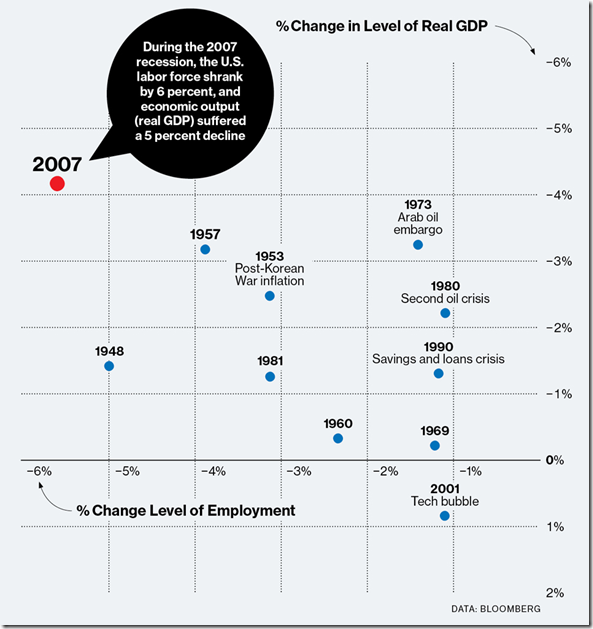
How bad was the recent recession
With a 6% decline in jobs and a 5% contraction in economy, the recession in 2007 was one of the worst in the past 60 years. See the graphical display by the Bloomberg
Subscribe to:
Posts (Atom)