Showing posts with label Pakistan. Show all posts

Monday, January 14, 2013

Toronto protests against Shia killings in Pakistan

Hundreds gathered at the Toronto City Hall on January 13 to protest against the senseless murders of Shias and other minorities in Pakistan. Pakistan Development Fund, a Toronto-based student group, organized the event in which religious and other groups also participated.

A girl protesting Shia killings in Pakistan

A girl protesting against sectarian violence in Pakistan, Toronto, January 13, 2013

While the Hazaras sat with the coffins of their children who died in targeted bomb attacks on January 10, 2013, millions in Pakistan joined the grieving parents by holding protest rallies against the senseless and targeted violence against minorities in Pakistan. The Hazaras have particularly been an easy target because of their unique features that set them apart from the rest. In the past year alone, hundreds of Hazaras have died in bomb blasts and targeted killings.

Standing in the rain outside of Toronto’s iconic City Hall, the protesters raised slogans against the unabated violence against minorities in Pakistan. The chants of “We want justice, stop Shia killings” resonated in Toronto’s downtown core, which is otherwise a quiet place on a Sunday afternoon.

Speaking at the event leaders of the Hazara community in Toronto warned that the protest in Toronto and other large cities in North America and Europe should alert Pakistan’s civil and defence establishment to the reality that what goes around in Pakistan is not lost on the world, especially the Pakistanis living abroad. Furthermore, while it may be true that misguided patriotism may have made Pakistanis ignore violence and injustice in Pakistan in the past, this is no longer the case.

Others warned that Pakistanis protesting against injustices in Pakistan is indicative of the fact that Pakistan now was part of the group of rogue states whose own citizens have to alert the rest of the world to the injustices being committed in their homelands. Such acts suggest the lack of confidence in the State and its agencies to establish the rule of law in Pakistan, one protester observed in Toronto.

Ayyaz Mallick, a student at Toronto’s York University, is one such Pakistani who believes that the state and its institutions do not represent the Pakistan he has envisioned. A Sunni Muslim himself, Ayyaz organized the rally with other university students in Toronto to show solidarity with Shia Hazaras who have been sitting on Quetta’s Alamdar Road with the coffins of 76 young men who died in two bomb attacks at a popular billiard club, which was mostly frequented by the Hazara youth.

Speaking at the rally in Toronto Ayyaz asked if the State was indeed even concerned about representing the interests of the marginalized communities in Pakistan. He urged Pakistanis back home and in diaspora to be on the streets to register their protest against targeted killings of minorities in Pakistan and ethnic cleansing of Shia Hazaras in Quetta.

Dr. Alia Ali, a resident of Toronto, observed that in the climate of despair and gloom there was still some hope left when she saw Sunni students at Toronto’s universities arranging protests to register their support for the Shias in Pakistan.

As the protest wound down in downtown Toronto, the protest on Alamdar Road in Quetta continued. It was only hours later that the Prime Minister of Pakistan, Raja Parvez Ashraf, committed to imposing emergency and Governor’s rule in Balochistan. This made many in Toronto wonder why the government waited for days to take this decision. Apart from facing the indignity and immense grief of sitting on a street with the dead bodies of 75 young men, not much changed between Thursday and Sunday for the government to realize that the Balochistan has not been governed at all in the past four years, said a long-term resident of Toronto in a telephone interview.

While the Hazaras are busy burying their dead in Quetta’s Bahisht-e-Zahra cemetery, where hundreds of other victims of violence are also buried, many in Pakistan wonder why their elected governments are so reluctant to govern.

-- Reporting and videos by Murtaza Haider

Wednesday, February 15, 2012

Can Pakistan survive without US aid?

Earlier this week I participated in an hour long dialogue on what has been happening in Pakistan as of late. The video footage from TVO is available below.

2011: A troublesome year in Pakistan

I ended up in a debate with an esteemed participant who argued that Pakistan cannot survive without US aid. I wrote an op-ed for the Daily Dawn in Pakistan exploring the question can Pakistan survive without US aid?

http://www.dawn.com/2012/02/15/can-pakistan-survive-without-us-aid.html

Some fact-checking is indeed in order. Pakistan is a $175 billion economy. Since 2002, the US has provided on average $825 million annually in economic assistance to Pakistan. On the other hand, Pakistani expatriates have remitted on average $1 billion each month in 2011, making remittances an order of magnitude higher than what the US has been providing to Pakistan. I would argue that Pakistan’s economy owes much more to what the expatriates contribute than what comes in charity from the United States.

Wednesday, November 2, 2011

The misguided priorities of Pakistani academics

 When one thinks of the grave challenges Pakistan has faced in the past three decades, Chemistry, Zoology and Urdu literature do not come to mind. One sees poverty, income inequality, food security, water shortages, infrastructure deficits, illiteracy, violence, wars, religious fundamentalism and sectarianism as some of the challenges that threaten the survival of the society and the State. It is hard to comprehend why academics in Pakistan would avoid focusing on the immediate challenges, but instead focus on subject areas where their impact will, at best, be marginal because researchers in Europe and North America have significantly more capital, infrastructural, and other intellectual resources at their disposal than their counterparts in Pakistan...

The misguided priorities of Pakistani academics | Blog | DAWN.COM
Enhanced by Zemanta

Wednesday, September 21, 2011

Where are the women tax payers in Pakistan? | Blog | DAWN.COM

Nowhere else is the gender gap more pronounced in Pakistan than in the income tax rolls where more than 99 per cent tax payers are listed as males.

With almost 50 per cent of the population, women account for less than 1 per cent of all income tax payers in Pakistan. The reason for women’s absence from income tax rolls perhaps lies in the manner women are integrated in the workforce. Women’s labour force participation rate in Pakistan is rather dismal at around 14.4 per cent. Bangladesh, on the other hand, reports a three-times higher rate than Pakistan for women’s participation in the labour force. Furthermore, women in Pakistan are often employed in low paying jobs or jobs that do not compensate monetarily. However, the above arguments fail to explain why fewer than 1 per cent income tax payers are women.

It is not that Pakistan lacks affluent women. There are several empowered, influential, and wealthy women in Pakistan such as Begum Abida Hussein (who represents the landed gentry), Sharmila Farooqi (who represents the new breed of female political mavericks), and Dr. Maleeha Lodhi (who represents the intellectual elite). Could it be true that this very visible minority of enfranchised women obscure the fact that despite their prominence they belong to a very small cohort which accounts for fewer than 1 per cent of the taxpayers in Pakistan. Or it is true that women are reluctant to file income tax in Pakistan.
Where are the women tax payers in Pakistan? | Blog | DAWN.COM
Enhanced by Zemanta

Monday, July 25, 2011

Victims of last year's floods in Pakistan

For more photographs of children still stuck in camps one year after the devastsating floods in Pakistan, please cllick on the link below:


Pakistani Perspective: Not a care in the world – The Express Tribune
Enhanced by Zemanta

Thursday, June 30, 2011

Osama Bin Laden's 'intriguing handwritten notes'

BBC has reproduced an image of handwritten notes recovered from the building in Abbotabad, Pakistan, which reportedly housed Mr. Bin Laden for years. There is debate about the authenticity of the document.

Without knowing much about the content in the text below and also pleading ignorance of OBL's handwriting from the past, I can certainly say one thing: there are too many harakaat listed in the document that gives the impression that the document was produced by or for a non-native Arabic speaker who would need the harakaat to know how to pronounce the words in Arabic correctly.


BBC News - Osama Bin Laden's 'intriguing handwritten notes'
Enhanced by Zemanta

Tuesday, June 28, 2011

Millions of Afghans to go hungry

Logo of the UN World Food Programme in SVG formatImage via WikipediaAs the NATO starts to wind down its operations in Afghanistan, the humanitarian organizations also start planning their exist. An unfortunate development in Afghanistan involves the World Food Programme (WFP) who announced recently that owing to insufficient funds, it will be unable to feed millions of Afghans.

This is a repeat performance from the last US exit from Afghanistan. As the Americans deserted Pakistan and Afghanistan in the mid eighties, the aid agencies followed the suit. WFP is perhaps offering a repeat performance.

International Development - WFP Downsizes Afghan Food Aid Operations
Enhanced by Zemanta

Monday, June 27, 2011

Uzbek couple bombs Pakistani police station

Uzbek in Hojent with his son.Image via WikipediaFor years it was known that the militants from the Soviet Caucasus were active in Pakistan, getting trained to target Russian interests. It is becoming increasingly evident now that the Uzbeks and other militants are in fact being used as beachheads in Pakistan by the local Pushtun-based militants.

Earlier, an Uzbek husband and wife team blew themselves up in a coordinated attack on a police station in Kolachi that involved six other militants. This should be sufficient evidence for defence strategists in who have also spoken about Pakistan's strategic depth and have justified rearing militants from Pakistan and abroad.

No one is more vulnerable to such attacks than the Pakistani themselves. The misguided policies followed by the so-called defence experts in Pakistan have turned the country into a tinderbox. This is certainly not a sustainable state for Pakistan who is now becoming the biggest victim of the militants it has reared over the past three decades.


Pakistani Taliban threaten husband-and-wife bombings | Pakistan | DAWN.COM
Enhanced by Zemanta

Sunday, May 15, 2011

Lawrence Solomon: Pakistan would work better in pieces | Full Comment | National Post

Sindh Arts College now renamed as D. J. Scienc...Image via WikipediaLawrence Solomon in Canada's The National Post presents one of the most reductionist and naive analysis of the challenges in Pakistan. It appears to me that he perhaps has never visited the places he now wants to split as independent countries.

He argues that the province of Sindh would prosper as an independent country because "Sindh would be a coherent country that could develop without the many contradictions that come of needing to live within an incoherent federal structure."

Mr. Solomon is most certainly unaware of the bloody ethnic/linguist/cultural wars that are taking place in Sindh, which have claimed the lives of hundreds in the past six months alone. The fact that Sindh is made up of the Urdu/Pushto speaking urban areas and Sindhi speaking rural areas is lost on Mr. Solomon.

Given the complexities involved in analyzing the challenges faced by Pakistan, one hopes that newspapers may want to consult those who may know a thing or two about the place.

Lawrence Solomon: Pakistan would work better in pieces | Full Comment | National Post
Enhanced by Zemanta

Monday, April 18, 2011

Good news: IMF says no to Pakistan

IMF Headquarters, Washington, DC.Image via WikipediaA high level delegation of Pakistan's economic and financial minders has been turned down by the IMF for additional funds. While some may think it as a negative outcome, I believe this is a great news. I hope that sooner than later all lenders stop extending loans and grants to Pakistan.

Such a move would lead to very tough economic times in Pakistan. However, without such drastic measures, there is no hope of Pakistan ever being able to become economically sustainable.

Pakistan has borrowed, begged, and manipulated its way out of the economic mess for the past six decades. The time has come for Pakistan to find its own solutions for its own problems.

Read further details of the IMF visit in a story by Dawn's Anwar Iqbal.

Pak team returning without money | Newspaper | DAWN.COM
Enhanced by Zemanta

Sunday, April 17, 2011

If only they'd listen

From Dawn.com:

ISLAMABAD: Chief Justice Iftikhar Mohammad Chaudhry said on Saturday the oath of the armed forces called for true allegiance to Pakistan by upholding the Constitution and by keeping away from political activities.

“I am persuaded to say this (because) during my talks with one or two very high-ranking officers, I discovered that they did not know the implications of the oath taken by the troops of Pakistan,” the chief justice observed in an address to a delegation of officers of the Command and Staff College, Quetta, at the Supreme Court building here.

Justice Iftikhar Muhammad Chaudhry administers...Image via Wikipedia


CJ asks military to keep away from politics | Newspaper | DAWN.COM
Enhanced by Zemanta

Thursday, April 14, 2011

The Turkish doner kebob served with the Taliban sauce

PL-4785Image by Community Eye Health Journal photos via FlickrIt is slowly going to dawn on the American policy-makers that it is impossible to sideline the largest ethnic group in Afghanistan, the Pushtuns. The other important lesson for the Americans to learn is that the Taliban now hold sway over most Pushtuns in Afghanistan. This fact is not lost on Afghanistan's neighbours, Pakistan, and Iran, and others in the region including Turkey.

Thus the Turkish offer to recognize Taliban as a political force in Afghanistan and Pakistan's endorsement of the Turkish offer represent the fast-evolving balance of power in Afghanistan.

The fact that the Taliban are a  regressive force may not be a dominant concern for the neighbouring powers who are now occupied more with restoring normalcy in the region that has suffered significant political turmoil resulting in the the death of hundreds of thousands of Afghanis, Pakistanis, and others. A large number of those killed or injured are civilians caught in the crossfire between the murderous ideologies pursued by the Taliban and the NATO.

The hubris-laden defense policy pursued by Americans and the NATO may soon be exposed for its shallowness and shortsightedness when NATO's departure from the region would restore the balance in the Taliban's favour. One must then ask the question about the utility of a policy that achieved nothing but destroyed the lives and the livelihoods of one of the most deprived people on the planet.

Pakistan would back Taliban office in Turkey: official | World | DAWN.COM
Enhanced by Zemanta

Monday, April 4, 2011

Murderous suicide bombers play havoc in Pakistan

After an attack on a sufi shrine in DG Khan in Pakistan that left almost 50 dead, another suicide bomber killed at least eight more in Dir.

Days earlier, it was reported that Fazlur Rahman, a hardline religious politician who backs various Taliban outfits, was also targetted twice by the suicide bombers. He escaped unhurt. Scores others who died in the attacks were not as fortunate as the conservative politician from DI Khan.

Teenaged suicide bombers in Pakistan expose the ills resulting from the social and economic collapse in Pakistan. In the absence of any foster care programs, the orphanages do not have the capacity to deal with orphans or abandoned children in Pakistan. The religious schools operated by the Jihadis are the only place where orphans and abandoned children find temporary refuge. While an overwhelming majority o religious schools provide education and shelter to such children, other religious/militant outfits turn such children into fodder for war. This exposes the rot in the society in general and in the conservative sections in particular.

Suicide bomber kills eight in Lower Dir | Provinces | DAWN.COM
Enhanced by Zemanta

Sunday, March 27, 2011

Pakistan fails in basic education

By Nosheen Abbas

http://english.aljazeera.net/photo_galleries/centralsasia/20113219931992945.html 

A tiny child looks into the camera and timidly states his plight. "A brick fell on my head," he says, almost whimpering. "What happened then?" the interviewer asks. "I got head injuries," he replies simply, obviously traumatised by the crumbling ceiling in his school.

This video clip was part of a presentation shown during the launch of Pakistan's March for Education Campaign. According to the campaign, 30,000 school buildings in Pakistan are in such a poor state that they pose a threat to the wellbeing of the children being taught in them. A further 21,000 schools have no building whatsoever.

These are just two of the shocking facts revealed by the Emergency Education Pakistan report produced by the Pakistan Education Task Force (ETF), which was created in 2009. The task force, which was set up with the approval of Yousuf Raza Gilani, the prime minister, is a non-partisan body that includes representatives from federal and provincial governments as well as non-governmental experts. It is co-chaired by Pakistani politician Shahnaz Wazir Ali and Sir Michael Barber, an international expert on education reform and former education advisor to Tony Blair during his time as British prime minister.

Throughout the month of March, the task force is working to raise the profile of the plight of Pakistani education in the hope of building popular demand for action.

'A self-inflicted disaster'

To convey the extent of the challenge facing the country, the report has drawn parallels equating the cost of the failure to educate the country's citizens with the cost of enduring one flood each year, adding: "The only difference is that this is a self-inflicted disaster."

Roughly one-in-ten of the world's primary school aged children who are not in school live in Pakistan - placing Pakistan in second position on the global ranking of out-of-school children.

Arshad Bhatti, the task force's political engagement strategist, believes their mission can be broken down into three main steps: Getting every child into school (something they call the retention and learning stage), while simultaneously improving the management and quality of public schooling and establishing some kind of financial commitment from the government.

Since it briefed the media and relevant technocrats on the report on March 9, the ETF has had high profile meetings with the prime minister, Asif Ali Zardari, the president, and Raza Rabbani, the minister for inter-provincial coordination. But, despite the fact that on April 19, 2010, the government passed an amendment to the constitution which included an article stating the constitutional right of every child to receive an education, collective political will remains questionable.

But Bhatti is optimistic. "The prime minister declared 2011 as the year of education, and we are seeing that senior politicians are taking this seriously," he said, adding: "I think there can be an education revolution when the political will is there."

Tazeen Javed, the task force's communications consultant, says the first phase of the British government-backed campaign will run until the end of March, after which "there will be a phase two and we're going to scale up efforts above and beyond approaching technocrats".

Perhaps the most interesting aspect of the campaign is that it was initiated from within the government with the aim of appealing to the government to increase its spending on education. And in the current economic climate, that may be a challenge too far.
Financial obstacles

After the passage of the yearly budget, the Pakistani government decided to increase taxation - in what could be said to have amounted to a 'mini budget'. To meet International Monetary Fund (IMF) conditions, the government is increasing taxation and curbing spending - something that only seems likely to add more rungs to the ladder the ETF must climb if it is to succeed in its aims. In such economic circumstances, it seems unlikely that the education sector will get the share of the budget it both needs and deserves.

"The efforts need to be bipartisan and we want now that if the budget for education can't be increased then they should not decrease it - that is what we have to fight for," says Fasi Zaka, the campaign's spokesman.

The fear that spending on education might, in fact, be cut, is very real; in 2005/2006 the Pakistani government spent 2.5 per cent of its budget on schooling, it now dedicates just 1.5 per cent of its budget to education. That is less than the subsidies given to Pakistan International Airlines (PIA), Pakistan Electric Power Company (PEPCO) and Pakistan Steel.

In addition, when provinces are allocated funds for education they often fail to spend all the money - mainly due to a lack of absorption capacity. The ETF is hoping to combat this via a petition that is being circulated on the internet and which it will eventually present to four provincial chief ministers.
"Education is now a constitutional right and the provinces are in the driving seat," says Bhatti. "They need to be convinced that there is a big demand for this, which there is. We need better political leadership now."
Good news?
Provincial governments are promising to take solid steps towards educational reform - and news of action is emerging much more promptly than is usually the case.
According to Bhatti, Shahbaz Sharif, the chief minister of Punjab, has taken personal responsibility for the campaign in Punjab and is due to announce a far-reaching road map for access to and quality of education. The aim is to accelerate the delivery of the campaign's goals by meeting regularly to keep tabs on the progress of reform. Longer-term trajectories involve real action within the electoral term.
In Balochistan, the chief minister and education secretary have also committed to a plan for the province with a series of immediate steps to be undertaken.
And in the wake of the floods, the planning department of Sindh has realised that it must consolidate smaller schools into larger comprehensive schools and accelerate the delivery of quality education to its residents.
The ETF is working closely with the provincial governments in Sindh, Punjab and Balochistan to push this initiative towards the execution phase.
A media revolution

The ETF has been trying to partner with Pakistani media to raise the profile of their campaign and in the weeks since the Emergency Education Pakistan report was launched there have been 60 news articles, including op-eds, and six television shows on the topic. More are expected in coming weeks.

But with the media frenzy surrounding the Raymond Davis story – the CIA contractor charged with killing two Pakistani men in Lahore – and the cases of two high profile Pakistani politicians who were murdered over their positions on the country's blasphemy law, to say the competition for column inches is intense is an understatement.

And education has traditionally been a near invisible topic in the Pakistani media. "We wanted to make noise about this issue," Tazeen says. And it seems to be working. Zardari was quoted using the term "education emergency" during a meeting with the minister of education and literacy in Sindh on March 15.

The ETF is understandably taking credit for this statement as no political figure in Pakistan has ever previously publicly referred to the deplorable state of Pakistani education as an emergency.

But will the hype the ETF has managed to manufacture last? And will it translate into results?

"Proliferation of the media hasn't been good - for example, as it was on Governor Taseer's assassination. But across the political divide people have gone against news pressure, those who are invested in the good of Pakistan," says Zaka.

He believes that while the hype about education will eventually die down, it will leave a trail behind it. "There's been repetition of information and it'll keep coming up in the future," he says. "It won't be a concentrated effect but the education debate has been reset."

A global dimension?

Despite there being no proven direct correlation between the absence of education and extremism, the ETF feels that all of Pakistan's problems can ultimately be traced - directly or indirectly – back to its public education system.

"It's what we're teaching, the nuanced information, the books, the curriculum or just simply the lack of everything," says Zaka.

But, interestingly, Pakistani higher education was rated extremely highly during a recent 'Going Global' conference in Hong Kong.

"When you are spending and it is working you don't want to touch it," says Zaka. "But when it comes to law and governance issues, primary and secondary education is extremely important."

Looking within

While political will is being nurtured by the ETF, power holders and politicians must begin by improving the state of education in their own constituencies. It is also important to raise the profile of teaching – a profession widely viewed among the general public as a last resort after attempts at pursuing other career paths have failed. The value attributed to academia must also be increased.

The role of women – or rather the lack of it – in the process of national progress is perhaps the most critical element of Pakistan's education challenge. According to the Emergency Education report, in a population of approximately 160 million people, fewer than half of all Pakistani women have ever been to school – a figure that drops to just 35 per cent in rural areas. And, according to the World Bank, educating girls delivers a higher return than any other investment in the developing world.

With at least seven million children out of primary school, the report bursts the myth that there is not a high demand for education from parents, revealing that only four per cent of those whose children are not in school say they have "no use for education".

So far, politicians have made lofty promises to improve education, but they have all too often shown more bark than bite. Only sincere leadership can now stop the country from being swallowed whole by Pakistan's worst emergency to date.

Wednesday, March 23, 2011

Buses run the intercity commuting in Pakistan

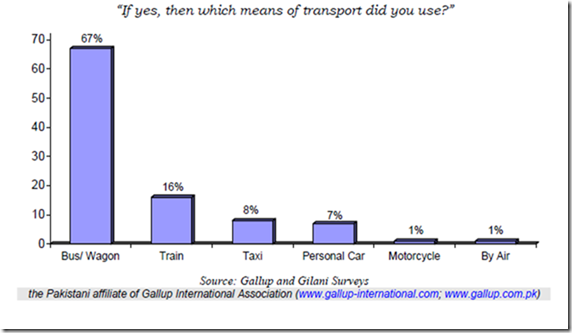
A Gallup poll conducted earlier in Pakistan has suggested that the intercity commuting in Pakistan is overwhelmingly dominated by buses and wagons, which command a huge mode share of 67%. Train was used by 16% of the commuters. Despite the concerns of increasing motorization, a mere 8% trips were made by cars. Air was barely present at 1%, suggesting the airline market has not yet started to mature in Pakistan.

clip_image002

http://www.gallup.com.pk/Polls/3-01-11.pdf

Monday, March 21, 2011

6-7m people joining the pool of poor each year

Poverty is fast increasing in Pakistan. The presidential task-force however has came up with the same export-driven solutions to address poverty. The lack of focus on the domestic consumer markets, which have failed to evolve in Pakistan, is surprising.

Textile exports are governed by complex quota systems that are driven by the ever evolving geo-political realities. Consumer markets in developed countries are also influenced by the domestic textile producers, who fight tooth-and-nail to prevent cheaper imports in their markets. Increasing textile exports from Pakistan will therefore be a very hard target to achieve.

On the other hand, developing domestic consumer markets for entertainment and other consumption is much easier to achieve. However, this is not favored by the experts who are often trained in macro-economics and do not understand the power of micro-markets.

For record, more than 70% of the US GDP comprises domestic consumption and not trade!

6-7m people joining the pool of poor each year | Newspaper | DAWN.COM
Enhanced by Zemanta

20,000 Kashmiris detained without trial in India

Amnesty International has reported that over 20,000 Kashmiris have been detained in the Indian controlled Kashmir without trial.

This is a major source of embarrassment for the world's largest democracy. India has no option but to address the genuine grievances of Kashmiris (Muslims and Pandits alike). So should Pakistan where the Kashmiris have been used as a pawn by various civil and military powerbrokers.

While Pakistan has no claim on being a democracy, given its struggles against military and civil dictatorships, India does claim to be the world's largest democracy. Incarcerating 20,000 without trial hurts India's standing among other democracies.

Kashmiris living in India and Pakistan have earned their right of self-determination after being suspended in a state of political vacuum since 1947. It is in India's and Pakistan's interest to resolve the issue of Kashmir by letting Kashmiris decide upon their own future. There is simply no other viable solution.

Kashmiris detained without trial in IndiaBBC News - Amnesty International criticises 'tough' Kashmir law

Enhanced by Zemanta

Thursday, February 24, 2011

The Vienna convention and Raymond Davis

Blackwater Worldwide's new company logo--refer...Image via Wikipedia
I am glad to see the New York Times has finally started to report on Raymond Davis, the American mercenary who shot and killed two youth in Lahore, Pakistan, after misreporting for weeks.

The US has backtracked after first identifying Mr. Davis as a technical officer affiliated with the US Consulate in Lahore. Now the US Government insists that Mr. Davis was attached to the embassy in Islamabad. The change in Mr. Davis' status is warranted by the fact that as an employee of the US Consulate, Mr. Davis would not be eligible for diplomatic immunity.

Consider Article 41 of the Vienna Convention on Consular Relations (1963). In Section II of the treaty, Article 41 focuses on Personal inviolability of consular officers. Part 1 of Article 41 reads:

“Consular officers shall not be liable to arrest or detention pending trial, except in the case of a grave crime and pursuant to a decision by the competent judicial authority.”

Source: http://untreaty.un.org/ilc/texts/instruments/english/conventions/9_2_1963.pdf

Murder is a grave crime. It is up to the competent judicial authority (Punjab High Court) to determine what truly transpired. If Mr. Davis truly acted in self defense, he should plead his case in the court of law.

Xe Training facility in San Diego, California
But the reality is that Mr. Davis was not even a CIA employee. Mr. Davis, who is a former member of the US Armed Forces and has reportedly worked for the notorious Blackwater, now Xe Services LLC . He was in Pakistan on a contract representing his own company, Hyperion-Protective Consultants LLC, whose address is listed as 5100 North Lane, Orlando, Florida. The address is also a cover-up because the leasing agent of the mall/office complex occupies that address. Furthermore, Pakistani newspapers have reported that Mr. Davis was stationed in Peshawar with the US Consulate for most of his stay in Pakistan.

The fact that the US government lied about his status in applying for his Visa should be a significant concern for the employees of the US State Department. This has put American foreign service employees in a bind because now even genuine US diplomats would now have to prove their bonafides.

Furthermore, what really needs to be debated in the international law is the legality of obtaining fraudulent visas. An individual not part of the US diplomatic core, or its armed forces, or its intelligence agencies, cannot and should not be carrying a diplomatic passport. The Vienna Convention, to the best of my understanding, covers only government employees, and not loosely attached contractors, mercenaries, and others.

There is also the grave concern about Mr. Davis' safety in Pakistan. Short of any other unexpected revelation, his acts could most likely be categorized as manslaughter, which is subject to section 307 of the Pakistan Penal code, rather than section 302, which carries death penalty. Even if he is trailed and convicted in Pakistan, it is highly unlikely that he be awarded capital punishment. Thus, it becomes Pakistan’s responsibility to prevent any harm to his person before and after the trial. One option could be that, if found guilty, he may serve his sentence in the United States, rather than in a prison in Pakistan.

I think it is not hard to imagine what the US government’s stance would have been if an ISI (Pakistan’s intelligence agency) agent on a diplomatic passport from Pakistan were accused of murdering two civilians or muggers in Soho, New York. The US government would have most likely declined immunity to an ISI operative?
Enhanced by Zemanta