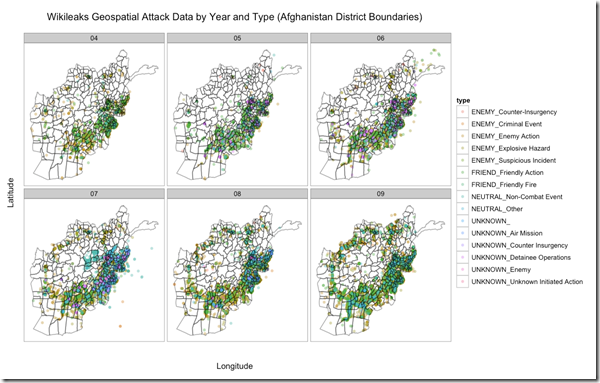
Based on the data retrieved from the Wikileaks it appears that the conflict in Afghanistan has spread over time. The following series of images present frequency of attacks in Afghanistan from 2004 to 2009. Notice that in 2004 (the upper left corner), most attacks were concentrated along the Afghanistan-Pakistan border, which is home to the Pashtuns in Afghanistan. This would also make sense since most Afghan Taliban are ethnic Pushtuns.
However, as one moves from 2004 to 2009, one sees a dramatic spreading of attacks along Afghan border, even along the Western border with Iran. The distribution of attacks in 2009 (lower right corner) suggests both an increase in the number of attacks as well as spreading of the conflict to parts of Afghanistan that were immune to the violence earlier.
It will be interesting to see what the latest numbers suggest in the post-surge Afghanistan.
Another interesting sidebar on the maps presented below is that the data analysis and the generation of the maps was done using R, which is a freeware stats software enabling social scientists to paint pictures with data that was not possible earlier.
Click on the image below to see the original post and a larger version of the image.
The above graphic has been produced by Drew Conway, who is a PhD student in political science at New York University. Drew studies terrorism and armed conflict; using tools from mathematics and computer science to gain a deeper understanding of these phenomena.
Image by Community Eye Health Journal photos via FlickrIt is slowly going to dawn on the American policy-makers that it is impossible to sideline the largest ethnic group in Afghanistan, the Pushtuns. The other important lesson for the Americans to learn is that the Taliban now hold sway over most Pushtuns in Afghanistan. This fact is not lost on Afghanistan's neighbours, Pakistan, and Iran, and others in the region including Turkey.
Thus the Turkish offer to recognize Taliban as a political force in Afghanistan and Pakistan's endorsement of the Turkish offer represent the fast-evolving balance of power in Afghanistan.
The fact that the Taliban are a regressive force may not be a dominant concern for the neighbouring powers who are now occupied more with restoring normalcy in the region that has suffered significant political turmoil resulting in the the death of hundreds of thousands of Afghanis, Pakistanis, and others. A large number of those killed or injured are civilians caught in the crossfire between the murderous ideologies pursued by the Taliban and the NATO.
The hubris-laden defense policy pursued by Americans and the NATO may soon be exposed for its shallowness and shortsightedness when NATO's departure from the region would restore the balance in the Taliban's favour. One must then ask the question about the utility of a policy that achieved nothing but destroyed the lives and the livelihoods of one of the most deprived people on the planet.
After an attack on a sufi shrine in DG Khan in Pakistan that left almost 50 dead, another suicide bomber killed at least eight more in Dir.
Days earlier, it was reported that Fazlur Rahman, a hardline religious politician who backs various Taliban outfits, was also targetted twice by the suicide bombers. He escaped unhurt. Scores others who died in the attacks were not as fortunate as the conservative politician from DI Khan.
Teenaged suicide bombers in Pakistan expose the ills resulting from the social and economic collapse in Pakistan. In the absence of any foster care programs, the orphanages do not have the capacity to deal with orphans or abandoned children in Pakistan. The religious schools operated by the Jihadis are the only place where orphans and abandoned children find temporary refuge. While an overwhelming majority o religious schools provide education and shelter to such children, other religious/militant outfits turn such children into fodder for war. This exposes the rot in the society in general and in the conservative sections in particular.
The World Food Program (WFP) has decided to stop its operations in Pakistan after a bomb in the tribal areas killed 45waiting in line for food disbursements at a distribution centre operated by WFP in Pakistan’s tribal areas. This is the second time WFP has been hit in Pakistan with deadly outcome.
There is no morals left in the war on terror. As the collateral damage from the American bombings sends more civilians to the morgue, their surviving clan members attack with vengeance against any one seen associating with a Western entity in Pakistan. UN, WFP, and the rest are no longer immune. This is indeed very sad for Pakistan.
The news media in North America and Europe has often criticized Pakistan for providing safe havens to the Taliban. However, those who work on ground know it well that the problem lies at the other side of the Durand Line.
President Karzai does not enjoy much control over Afghanistan beyond his presidential compound in Kabul and therefore any assertion that the government in Kabul enjoys any control over what goes on in Afghanistan beyond a tiny patch of a few square kilometres is absurd.
The following article in the Boston Globe offers that unique perspective on what goes on along the Pakistan and Afghanistan border.
---------------
A different story emerges from Pakistan
H.D.S. Greenway / Oct 29, 2010
KHUR, Pakistan
WHAT CAN we do about Pakistan, you ask, the source of so many troubles for the United States? You wonder: Why can’t or won’t Pakistan eject the Taliban terrorists from their safe havens, or stop them from crossing the border to kill our boys in Afghanistan?
Let me be your guide. If you want to hear a different narrative, come with me for a visit into the so-called “lawless tribal territories’’ on the Northwest Frontier where Pakistan and Afghanistan meet. Here the trouble is that the Americans aren’t stopping the Taliban from crossing over from their safe havens in Afghanistan to attack Pakistan.
Come, you have been invited to lunch at the officers mess of the Bajaur Scouts, gleaming with the regimental silver and leftover traditions from the British who once tried, but never succeeded, in taming the Pashtun tribes. Semi-autonomous tribes traditionally rule themselves rather than be under the direct control of the government.
But first we must drive over the storied Malakand Pass, leaving behind, as Winston Churchill described it, “under the haze of heat’’ the flat lands, up where “the landscape is wild and rugged,’’ and down again into a broad valley like a cup.
“The country of the plains is left … A single step has led from peace to war … and we have we entered a strange land’’ he wrote a century ago, and it still holds true today. For then as now, Pashtun religious zealots, then called Ghazis and now called the Taliban, are making trouble in the tribal territories.
In 2008 they had just about taken over Bajaur on the Afghan border by killing elders, destroying schools, and imposing their strict brand of Islam. The 26th Regiment, and the Scouts, cleared, held, and now they are building. The casualties were heavier than most American units have suffered across the border in Kunar Province.
Unlike the regular army, the Scouts are all Pashtuns themselves. The British formed these frontier Scouts on the theory that it takes a Pashtun to catch a Pashtun. But the Scouts tell us that they had forgotten what their grandfathers and great grandfathers had known, and had to re-learn the guerrilla warfare of which the Taliban are masters.
Today Bajaur is all but pacified, at least for now. The markets are open, people can move freely, teachers are back in their schools. It’s a success story, and that’s why we have been invited here. Don’t be alarmed that we are escorted by pickups full of armed Scouts with machine guns mounted on the cabs. That’s just a precaution. You are not in danger, except, perhaps, “from suicidals,’’ the scouts say, or perhaps a roadside bomb.
Listen to the tribal “elders.’’ They once again represent tribal authority which the Taliban broke down. In town the Scouts have left one of the telephone poles which was refitted to be a gallows by the Taliban. You can see caves that the Taliban dug to hide in — “like the Viet Cong,’’ says one of the Scouts who has read about the tunnels of Cu Chi in Vietnam.
But come and look at this map. Those hatched marks are the bits where Taliban are still active, to be mopped up. There, straddling the border, there’s the weak point! The British drew the border separating members of the same tribe, so the tribesmen have always wandered back and forth at will.
No matter how successful the Scouts and the 26th Regiment have been in clearing out the Taliban from Bajaur, they say the Americans and the Afghan Army in Kunar Province aren’t preventing the Taliban from coming over from their safe havens in Afghanistan. It’s not for lack of will. It’s just the reality of porous borders and frontier fighting.
Whether Pakistan’s national leaders want to keep good relations with some Taliban in other parts of the frontier, as a hedge against when the Americans leave, is a matter above the Scouts’ pay grade. All they know is that Talibs from safe havens in Afghanistan are coming over to kill their boys.
Not quite what you’re hearing back home?
H.D.S. Greenway’s column appears regularly in the Globe.
BBC has recently pointed out that the drone attacks in Pakistan under the Obama administration have increased manifolds. These pilot-less, remotely controlled aircrafts have been successful in killing key militants in Pakistan. However, these attacks have killed scores of innocent Pakistani tribesmen, which has resulted in a widespread opposition against the drone attacks in Pakistan.
The US government under President Obama intensified the use of drones in Pakistan. This comes as a surprise to many in both the United States and in Pakistan who naively believed that a change in White House implies a change in the Pentagon. The graph below however suggests that President Obama`s and installations in fact more trigger happy than the one it replaced.
The attacks by the militants on military forces and civilians in Pakistan, and drone attacks and other offenses launched by the Pakistani military against the militants have ended up in a tit-for-tat killing game in Pakistan, which is slowly but surely destroying the social, cultural, and economic fabric of the country.
Pakistan’s foreign minister, Shah Mahmood Qureshi, has revealed yesterday in Islamabad that 247 suicide bombings in the past nine years in Pakistan have left 5,550 dead and injured thousands more. Among the dead almost 3,000 were civilians.
Mr. Qureshi was speaking to the group ‘Friends of Democratic Pakistan’, which includes foreign firms with business interests in Pakistan. He further revealed that terrorism has cost Pakistan’s economy $43 billion. Incidentally, these gory stats were part of Mr. Qureshi’s sales pitch to attract further investment in Pakistan.
Mr. Qureshi’s numbers are highly understated. The total death toll resulting from terrorist violence in Pakistan, and not just suicide bombings, far exceeds what has been stated by the foreign minister. According to the statistics maintained by South Asia Terrorism Portal, which is headed by famed K. P. S. Gill, victims of terrorist violence in Pakistan during 2003-09 alone exceeded 25,000. This also includes 14,596 individuals killed by the security forces. The number of civilian victims at 7,598 far exceeds 5,550, as is maintained by the foreign minister.
Year
Civilians
Security Forces
Terrorists
Total
2003
140
24
25
189
2004
435
184
244
863
2005
430
81
137
648
2006
608
325
538
1471
2007
1523
597
1479
3599
2008
2155
654
3906
6715
2009
2307
1011
8267
11585
Total
7,598
2,876
14,596
25,070
Source: South Asia Terrorism Portal
No one is immune to the terrorist violence in Pakistan. In the mid seventies, when militancy started to take root in Pakistan, its victims were predominantly Shiites and other religious minorities. The military personnel became targets of terrorism only after 9/11 because religious extremists were not pleased with the Pakistani military siding with the Western coalition against the Taliban. As of late, the violence is targeted even at moderate Sunni Muslims as is evidenced by the recent suicide attack at the shrine of Lahore’s patron saint, Data Ganj Bakhsh.
The violence in Pakistan is unlikely to subside in the near future. The hate-laced propaganda is unlikely to stop flowing from Pakistan’s religious establishment, who is motivated by its religious convictions and encouraged at the same time by Pakistan's intelligence apparatus.
The military and civilian intelligence in Pakistan believes in maintaining a strategic depth against India by keeping religious extremists as reservists to be called in for service, if and when needed. Nothing could be more misguided than this notion of strategic depth that has inadvertently exposed the shallowness of Pakistan's social and economic foundations.
The same militants trained by the intelligence to fight against the Soviet and Indian armies are now busy killing Pakistanis in their homes, places of worship, and on streets. A nation of 180 million individuals now lives in a perpetual state of fear. Streets are devoid of life, and bazaars long for shoppers. The militants, who were once considered assets by Pakistan's intelligence, have now become a major liability.
Concomitantly, the Pakistani State has failed to provide even the very basic services, such as clean drinking water, sanitation, primary healthcare, and electricity to the masses. In its drive to achieve a strategic depth against India, Pakistan's intelligence apparatus has created a sorry state of affairs where the populace lives in fear and deprived of the very basic necessities.
While the state and the society continues to falter in Pakistan, the recent round of talks between Indian and Pakistani foreign ministers in Islamabad have ended without progress. Whereas many naively hoped for a major breakthrough, even a modest progress would have been a cause of celebrations across the border.
If such talks continue to fail in producing results, those who advocate dialogue risk losing ground to hawks in both India and Pakistan. One should never let this happen. The stakes are much higher for Pakistan than they are for India. Any dialogue between Pakistan and India should, for Pakistan’s sake, bring the two nations closer to resolving their outstanding issues, most important of which for Pakistan is no longer Kashmir, but is water and domestic terrorism.
Following the failed talks between the foreign ministers of India and Pakistan, any posturing by Pakistan fails to recognize that the country is at the precipice of an economic and social meltdown. With thousands of Pakistanis killed at the hands of other Pakistanis, there's not much room to dig for any strategic depth. Pakistan should try to preserve what it has than to aspire for what it lacks.
For Pakistan, this is the time to make compromises, admit faults, seek forgiveness for decades of transgressions, and chart a new path towards peace, prosperity, and tolerance.
To do anything else would seal Pakistan's disastrous fate.
The Sunni extremists in Pakistan’s tribal areas have yet again murdered 18 more Shiites in cold blood. The state in Pakistan has become a silent spectator in this game of death where the militant Sunnis, who once were backed by the Pakistani State and still enjoy the blessing of numerous state institutions, continue to kill Shiites and other religious minorities in Pakistan with impunity.
The latest violence has killed 18 Shiites from Kurram Agency in Pakistan’s tribal areas. Hundreds if not thousands of Shiite residents of Kurram Agency have been killed the Sunni extremists since the mid seventies when the American and Saudi-funded Arab and Afghans launched a civil war in Afghanistan.
More from BBC below.
Militants kill 16 in Pakistan convoy ambush
A suspected sectarian attack on a civilian convoy in a troubled tribal area of Pakistan has left 16 dead.
Several other people were wounded in the ambush in the north west, where the army has carried out operations against Islamist militants.
The convoy, which was being escorted by security forces, was attacked in Char Khel village in the Kurram region.
All those killed were Shia Muslims, according to local officials, who said the death toll may rise.
The convoy was heading from Parachinar, in Kurram, to the main regional city of Peshawar when it was ambushed on Saturday in the predominantly Sunni region.
The Kurram tribal district has been a flashpoint for violence between the minority Shias and the Sunni community for several years.
Some reports put the number of dead at 18, including two women.
Jamshed Tori, who was wounded in the attack, told the Reuters news agency: "Militants attacked the last two vehicles in the convoy with automatic weapons near Char Khel village, killing 18 people."
A tribal leader, Mussrat Bangash, also confirmed the deaths.
Kurram has been hit by scores of attacks, including robberies and kidnappings for ransom, in the past three years.
The army has reportedly killed nearly 100 militants in operations in the region, close to the Afghan border, in recent months.
Several major suicide attacks have hit Pakistan in recent weeks. An attack on Thursday killed at least five people in the Swat Valley, also in north west.
Earlier this month, a pair of suicide bombers blew themselves up in the Mohmand tribal region, killing more than 100 people.
The Pakistani government is under US pressure to crack down on the unrest in the border region.
The Shia minority accounts for some 20% of Pakistan's population of 160 million.
More than 4,000 people have died as a result of sectarian violence between Sunnis and Shias since the late 1980s.



 a surprise to many in both the United States and in Pakistan who naively believed that a change in


