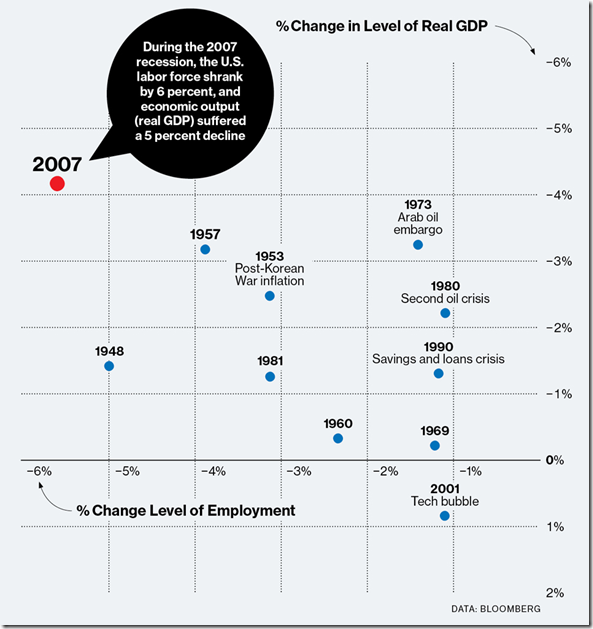
With a 6% decline in jobs and a 5% contraction in economy, the recession in 2007 was one of the worst in the past 60 years. See the graphical display by the Bloomberg

With a 6% decline in jobs and a 5% contraction in economy, the recession in 2007 was one of the worst in the past 60 years. See the graphical display by the Bloomberg
Fewer babies per family means healthy babies, healthy mothers, longer lives and prosperity for all. If it sounds like a commercial for family planning, remember buchay do hi acchay (two kids are enough), than you’ve guessed it right. There is enough global evidence from the past four decades to advocate lowering fertility rates in low-income countries.
Using data from the World Bank and animation technology provided by Google, I illustrate below that life expectancy at birth increases with the decline in fertility rates. Also, as the fertility rates drop, the health of the society improves as is evidenced by a decline in infant mortality rates. Furthermore, societies become more prosperous with the drop in fertility rates.
Let’s look at the animated graph below that demonstrates the evolution of four human development indicators from 1960 to 2008:
Click on the play button located immediately below the graph to its left to view development indicators evolve from 1960 to 2008. I have, for comparison, highlighted Afghanistan, Bangladesh, India, Iran, Pakistan, and Saudi Arabia on the graph so that you can visually track their performance over time.
You can also pause the animation at any time, and can use the horizontal bar under the graph to move to a particular year to see the indicator values. You can also point and click on the graph to determine values for each individual country at any point in time.
The animation reveals a dramatic decline in fertility rates starting in mid eighties for most countries, including Pakistan, Bangladesh, Iran and Saudi Arabia. Iran, in fact experienced the fastest decline in fertility rates of the highlighted countries and ended with 1.8 births per woman in 2008. Bangladesh and India are also not far behind followed by Saudi Arabia.
So why is the fertility rate still very high in Pakistan? And can the sluggish socio-economic growth in Pakistan be explained by the abovementioned dependencies between high fertility and mortality rates, lower longevity, and less prosperity? At approximately four births per woman in 2008, the fertility rate in Pakistan is very high and is comparable to the one observed in very impoverished African states. As mentioned earlier, the fertility rates in Saudi Arabia and Iran, the two primary religious influences on Pakistan’s Sunni and Shiite schools of thought, have declined sharper than that of Pakistan.
A key obstacle to lowering fertility rate in Pakistan is the religious establishment, which has opposed any such move by the state. Convinced that the Creator has guaranteed sustenance of every living organism, which I wholeheartedly believe as well, the semi-literate mullahs preach against the use of contraceptives and consider birth control sacrilegious since such practices in mullahs’ interpretation of the faith may question the Creator’s ability to provide for its creations.
But the Creator has also blessed human beings with intellect and wisdom that encourage one to live within one’s means. And how would one explain the much steeper decline in fertility rates in Bangladesh, which until 1973 was part of Pakistan. The fertility rate in 1974 in Bangladesh was 6.83 births per woman against 6.96 in Pakistan. By 2008, fertility rate in Bangladesh declined to 2.34 births per woman, a staggering 41% lower than that of Pakistan.
While mullahs in Pakistan have thwarted any attempt by the State to lower fertility rates, Saudi Arabia and Iran have lowered their fertility rates at much faster rates in the past three decades than Pakistan. The average number of births per woman in Saudi Arabia declined from over seven children per woman in 1982 to just over three in 2008. In Iran, the same rate drop from 6.6 births per woman in 1982 to 1.8 births in 2008.
The reason for this dramatic decline in fertility rates in Iran and Saudi Arabia is the improved access to contraceptives for females in their childbearing age. So why the mullahs in Pakistan are not learning from their mentors in Iran and Saudi Arabia?
It is not just that the lower fertility rates are correlated with longevity, which is evidenced by a simultaneous increase in life expectancy, but lower fertility is also correlated with lower infant mortality. Fewer births per woman result in healthier infants and mothers, thus increasing the chance of infants to survive beyond the age of one. Higher birth rates deteriorate women’s health, especially with poor food quality, and thus lead to higher infant mortality.
If you look at the bottom right corner of the graph, you’ll see big blue circles representing rich European countries with lowest fertility and infant mortality rates, and the highest life expectancy at birth.
However, if you look at the upper left corner of the graph, you’ll see mostly poor African countries with high infant mortality rates, very low life expectancy at birth, and yes, high fertility rates.
At the very top left corner is Afghanistan. With the highest fertility rate at almost seven births per woman, Afghanistan also has the dubious distinction of having one of the highest infant mortality rates at 165 deaths per 1,000 live births, and lowest life expectancy of 44 years at birth. Years of war in Afghanistan has left it as the most impoverished country in the world.
While Afghanistan may not be able to turn its fortunes in the short run, it can at least focus on lowering its fertility rate. The Afghan mullahs are of the same ilk as the one in Pakistan, who vehemently oppose any family planning. However, the mullahs in Afghanistan and Pakistan need to be educated, and not in the western traditions, but about the transformation taking place in Saudi Arabia and Iran. If the Iranian and Saudi mullahs can consent to, or live with, family planning, then mullahs in Afghanistan and Pakistan should also acknowledge the evidence presented in the animated graph above, i.e., lower fertility rate means lower infant mortality, higher life expectancy, and yes greater prosperity.
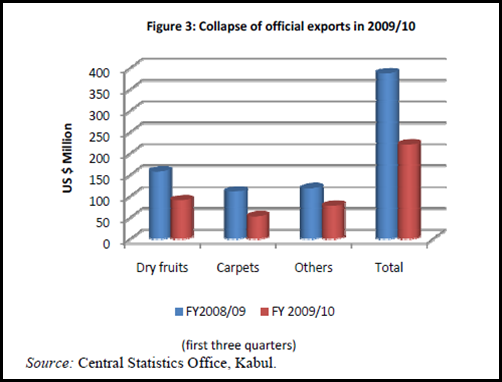
Chris Alexander, Canada’s former ambassador in Afghanistan, paints a false picture of Afghanistan in the Globe and Mail on Saturday by suggesting that "Afghan society has recovered smartly since 2001." To bolster his point he mentions that despite the global recession, Afghanistan's GDP grew by 22%. This indeed is a gross misrepresentation of Afghanistan's economy and society, which have literally collapsed in the past decade.

The World bank also noted that 75% of the foreign aid bypasses the Karzai government's budget system, making the government less legitimate and relevant to the Afghans.
Mr. Alexander also suggests that Afghanistan’s inflation “has been minus 12 percent.” This again is not only false, but poorly stated. By all accounts, inflation in Afghanistan has hovered around 30%, which has subjected poor Afghans, who make up the majority of the population, to extreme financial hardships. The recent estimates of a lower inflation does not apply to cities, such as Kabul, where ordinary Afghans can no longer afford to pay rents for even modest accommodation.
By suggesting that Afghanistan's economy is rapidly growing (which is also not factual), Mr. Alexander is in fact concealing the fact that the country is becoming increasingly dependent on charity, and on billions in debt forgiveness from the IMF.
Such misrepresentation of facts is tantamount to intellectual dishonesty, to say the least.